Features
The internal linking engine that shows every score
Link Pulse indexes published content, ranks internal link targets against eight weighted signals — each open to inspection — and reports orphan and underlinked pages, entirely on the WordPress installation already in use.
Internal linking that never leaves your site. The sections below are the mechanism behind that claim.
Indexing
What the index stores, and what it ignores
Published posts and pages are indexed. Free indexes post and
page only; Pro will cover all registered public custom post
types.
Per item, the index stores title, excerpt, headings, cleaned body text, taxonomy terms, slug, published date, parent/child relationship, inbound and outbound internal link counts, and any registered custom fields selected for inclusion.
Excluded by default: drafts, private content, password-protected content, trash, auto-drafts, revisions, menus, and attachments. Everything is stored in your own database tables. Nothing is transmitted.
The Free custom-field limit is stated in full: up to three custom fields, include-in-index mode only. Disclosed before installation, not discovered after it.
Scoring
Eight signals produce one match score
Every suggestion is a calculation open to inspection — not a model, not an inference.
| Signal | What it measures | Weight |
|---|
The weights sum to 1.00.
Reproducible
Same content, same settings, same results. Scores do not drift between runs, so a suggestion dismissed yesterday does not reappear ranked differently today for no reason.
Explainable
Each suggestion shows its match strength and the signals that contributed. Nothing is asserted without its basis.
Local
No model, no inference, no external call. There is nothing to accept on trust and nothing metered per request.
Why taxonomy leads
Shared words are weak evidence of relevance. A post titled “The Best Books of 2025” and a post titled “Best Camera Bags” share the word “best” and nothing else of substance. Shared taxonomy is much stronger evidence that two pieces of content concern related subject matter. Weighting taxonomy above title overlap prevents shallow word collisions from outranking genuine topical relationships.
The full scoring model, including normalisation and the overlinked penalty.
Editor
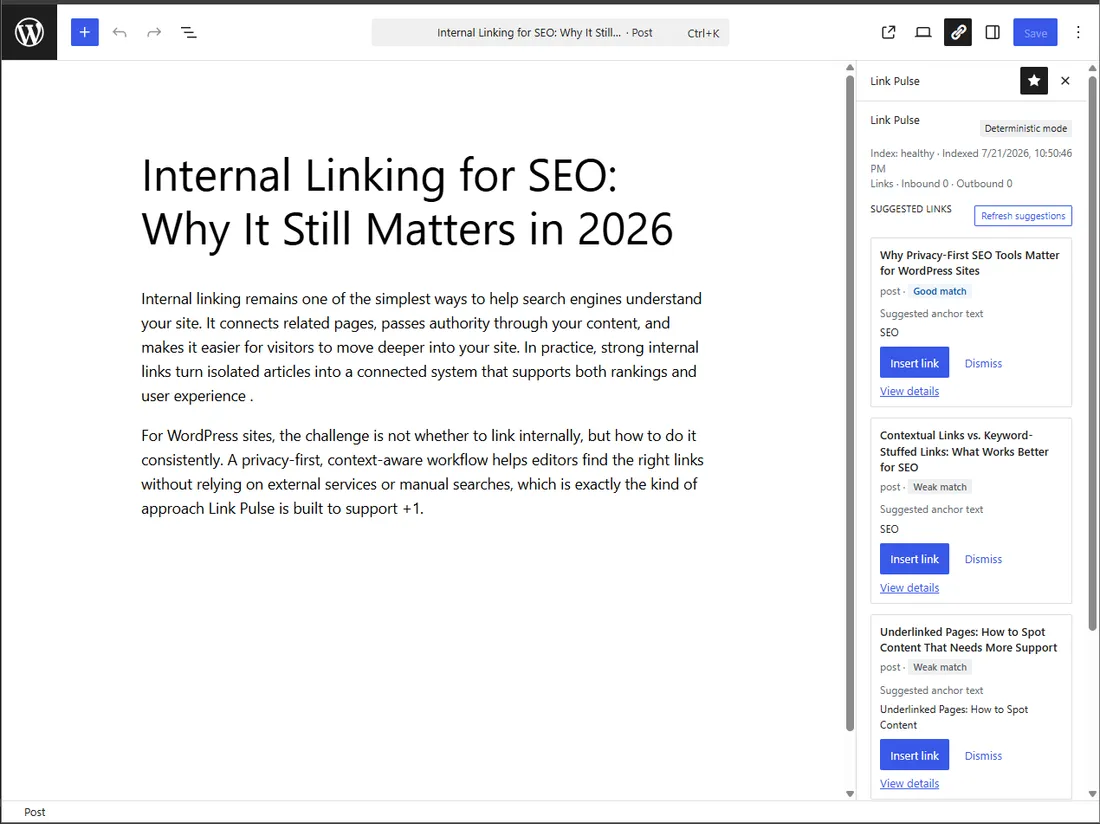
Suggestions surface in the block editor
Suggestions appear in a Gutenberg PluginSidebar during writing. It displays index health, inbound and outbound counts for the current post, ranked targets with match strength, suggested anchor text, one-click insert, and dismissals that persist.
Free displays no upgrade prompt in the sidebar. The writing surface remains a writing surface.
Context bank
Exclude pages that should never be link targets
The context bank controls what is eligible as a link target. Exclusions are total: an excluded page is neither suggested nor counted toward orphan and underlinked reports. Without this control, legal and utility pages would remain permanently on both lists.
Reports
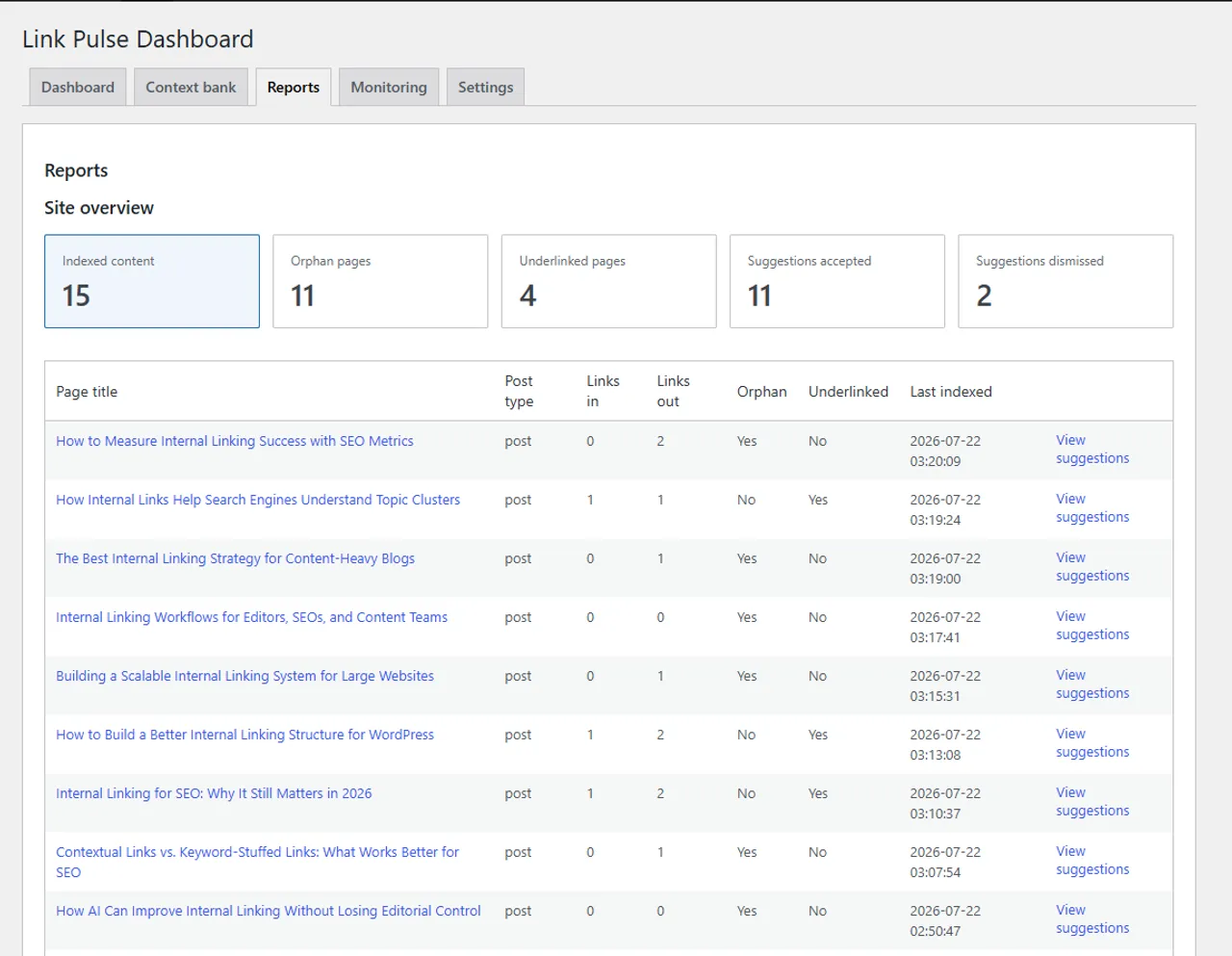
Find orphan and underlinked pages
Orphan pages have no internal links pointing to them. Underlinked pages have fewer inbound links than their importance calls for. Both reports are produced from the same local index.
The reports identify where the structural gaps are. They do not state what closing them will do to search rankings; no tool can make that determination with honesty.
Operations
Indexing runs in the background, never on page load
Indexing runs as a background job, not during page loads. Suggestions are served from the local index. Reindexing can be scheduled, and job health can be monitored from the admin.
On sites where background jobs depend on WP-Cron and traffic is low, indexing can stall. See troubleshooting for what to check.
Free and Pro
Free is complete. Pro adds more.
Link Pulse free version is the complete deterministic product. Link Pulse Pro adds optional AI reranking and broader indexing.
| Feature | Free | Pro |
|---|---|---|
| At a glance | ||
| Deterministic ranking on your install | Yes | Yes |
| Posts and pages | Yes | Yes |
| Custom post types | No | Yes |
| Custom fields | Up to 3, index-only | Yes |
| Optional AI reranking (BYOK) | No | Yes |
| Orphan and underlinked reports | Yes | Yes |
Free is not a trial. What ships in Free at 1.0 remains in Free.
Pro
What Pro will add
Optional AI reranking through your own provider key, custom post types, unlimited custom fields, and multi-provider support.
Free is not a trial. What ships in Free at 1.0 remains in Free.
Try Link Pulse on your own site
Install, run the first index, open a post, interlink with other posts.