Last updated
How ranking works
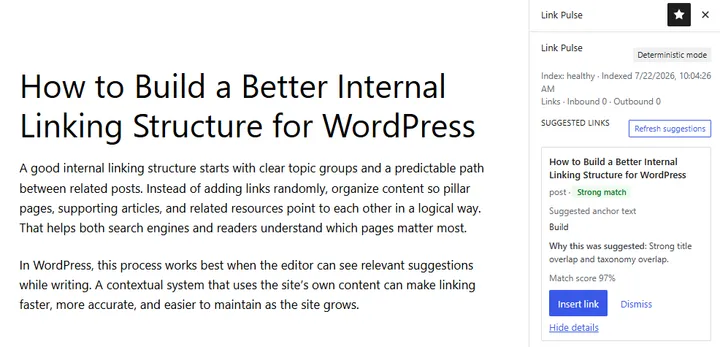
Link Pulse ranks internal link candidates with a deterministic model: same content, same settings, same result. There is no model inference and no external call. Every score is a calculation you can read.
The eight signals
Each signal is scored from 0.0 to 1.0, multiplied by its weight, then summed. The weights sum to 1.00.
| Signal | What it measures | Weight |
|---|
The weights sum to 1.00.
Why taxonomy leads
Shared words are weak evidence of relevance. A post titled “The Best Books of 2025” and a post titled “Best Camera Bags” share “best”; they share little else. Shared taxonomy is stronger evidence that two pieces of content are actually related. Weighting taxonomy at 0.30 — above title overlap at 0.20 — is what prevents shallow word collisions from outranking genuine topical relationships.
How the score is built
- Score each applicable signal from 0.0–1.0.
- Multiply by that signal’s weight.
- Sum the weighted values.
- Clamp the result to a valid match score range.
- Apply the overlinked penalty (below) after the weighted sum.
Match strength badges (Strong, Good, Fair, Weak) are labels on that final score for the sidebar — they do not change the calculation.
Applicable-signal renormalisation
Not every site uses every signal. Renormalisation decides what happens to a signal’s weight when it is not meaningful on your install.
If your site does not use a signal at all — for example you have no custom fields indexed, or almost no posts are tagged — that signal is dropped from the calculation. Its weight is not left in place to permanently cap every score.
If your site does use a signal, a post that lacks it takes a real zero on that signal. The weight is not redistributed onto title matching (or any other signal). Pushing unused weight onto title overlap would reward shallow word collisions — the failure taxonomy-first weighting exists to prevent.
Overlinked penalty
After the weighted sum, Link Pulse applies an overlinked penalty: a target that is already heavily linked internally scores lower than the same target would with fewer inbound links. The penalty does not replace the signal model; it adjusts the final score so suggestions prefer targets that still need links.
What is not a weighted signal
Slug relevance is used to find candidates. It is not one of the eight weighted signals in Free.
Reproducibility
Same published content, same context-bank settings, same index → same ranking. Scores do not drift between runs. A suggestion you dismissed does not reappear with a different unexplained score the next day.
Related: Editor sidebar, Context bank, Features.